 Free Starter Pack
Mandatory registration is expanding from July 2027. Start working out where you stand.
The Ledgecroft Provider Registration Decision Workbook: a registration checklist, cost planner and evidence workbook for sole traders and small disability support providers.
The workbook goes on sale after our final checkout test.
The high risk supports list isn't out yet. Your preparation doesn't have to wait.
Look at whether the registration changes are likely to affect your services, get your evidence down in your own words, and plan your next steps before you pay for professional help or an audit.


“We're being asked to prepare for something, but we don't know if it's a category one or category five cyclone.”
— a Cairns support worker, quoted by ABC News, 1 July 2026
ABC News reported in July 2026 that only 8 per cent of NDIS providers were registered, and that up to 90 per cent may need to be. If you're a sole trader doing a few shifts a week, it's hard to know where you fit.
Why we built this
Most preparation advice we read assumes the rules are already clear. They're not. Much of what we found for sale is a pack of policies for people who've already decided to register. We wanted something for the step before that: working through whether it's likely to apply to you, and what to do next.



Start here: a quick self-check
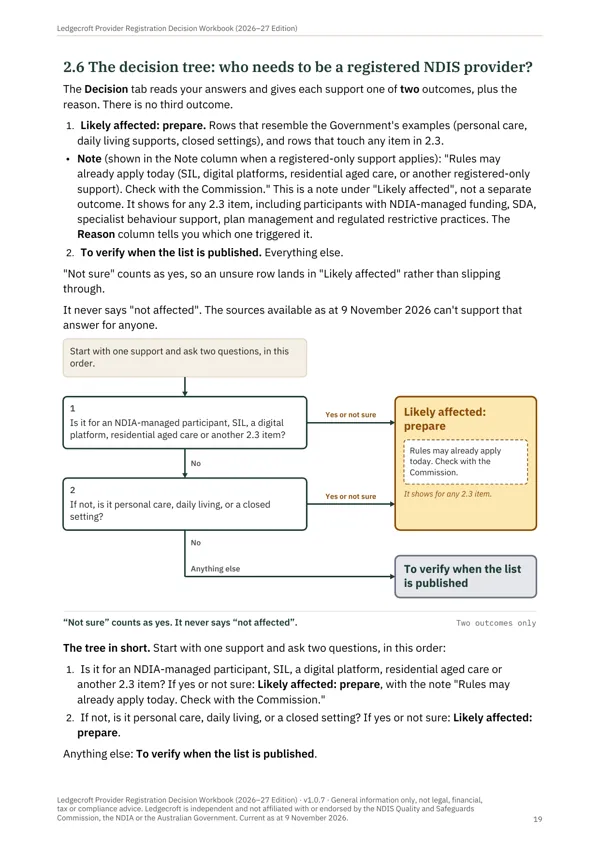
As at 9 November 2026 the official list of high risk supports hasn't been published. These five questions show you which parts of the changes are worth a closer look. If you're not sure, treat it as a yes.
Are you a sole trader or small provider delivering supports funded under participants' plans? From 1 December 2026, claims will need to be made within 90 days of the support being delivered, by whoever claims (you, the plan manager or the participant). And as a provider, you'll need to keep records about those supports for 7 years from the day each claim is made, whoever makes it.
Source: Act No. 66, 2026; DoHDA, “About the changes to the NDIS” (2 Oct 2026)
Do you deliver personal care or daily living supports? These are among the examples the Government has given for the expansion that starts rolling out from 1 July 2027.
Source: DoHDA, “About the changes to the NDIS” (2 Oct 2026)
Do you deliver supports in closed settings or supported independent living (SIL), support participants whose funding is NDIA-managed, or run an NDIS digital platform? The NDIS Commission describes a digital platform as an online app, website or system that acts as an intermediary between participants and the people providing their supports, where payments are processed through it using NDIS amounts from participants' plans, and whose main purpose is connecting participants with supports from their plan. Mandatory registration for SIL and digital platforms started on 1 July 2026.
Source: Commission, “Mandatory registration” (no date shown, accessed 9 Nov 2026)
Are you unsure whether your supports are in scope? That's normal while the official list is still to come.
Source: DoHDA (2 Oct 2026); Commission, “Mandatory registration” (accessed 9 Nov 2026)
Would it be hard to find the records for any support you've been paid for since 27 August 2026? NDIS providers have to keep records about their claims and the supports they delivered for 7 years from the day each claim is made. This applies to claims made from 27 August 2026, including when a plan manager or the participant makes the claim. The NDIS rules will set out which records.
Source: Act No. 66, 2026; DoHDA (2 Oct 2026)
If you're not sure, treat it as a yes.


Note: rules may already apply today. Check with the Commission.
Answers stay in the browser and aren't stored or sent.
Two outcomes only: amber triangle = Likely affected: prepare · grey circle = To verify when the list is published. Colour is never the only signal.
What you get
Decide what's likely to affect you
In the file: Supports · Group match · Decision
Compare up to three audit quotes
In the file: Quotes · Budget
Evidence in your own words
In the file: Evidence register
Screening, training, risk, incident, complaints and improvement registers
In the file: Screening & training · Risk · Incidents · Complaints · Improvement
90-day claiming rule
In the file: Claims log
7-year records
In the file: Records map
Registration vs NDIA enrolment
In the file: plain explainer in the PDF
Your action plan
In the file: Action plan · Calendar
See the real pages before you buy
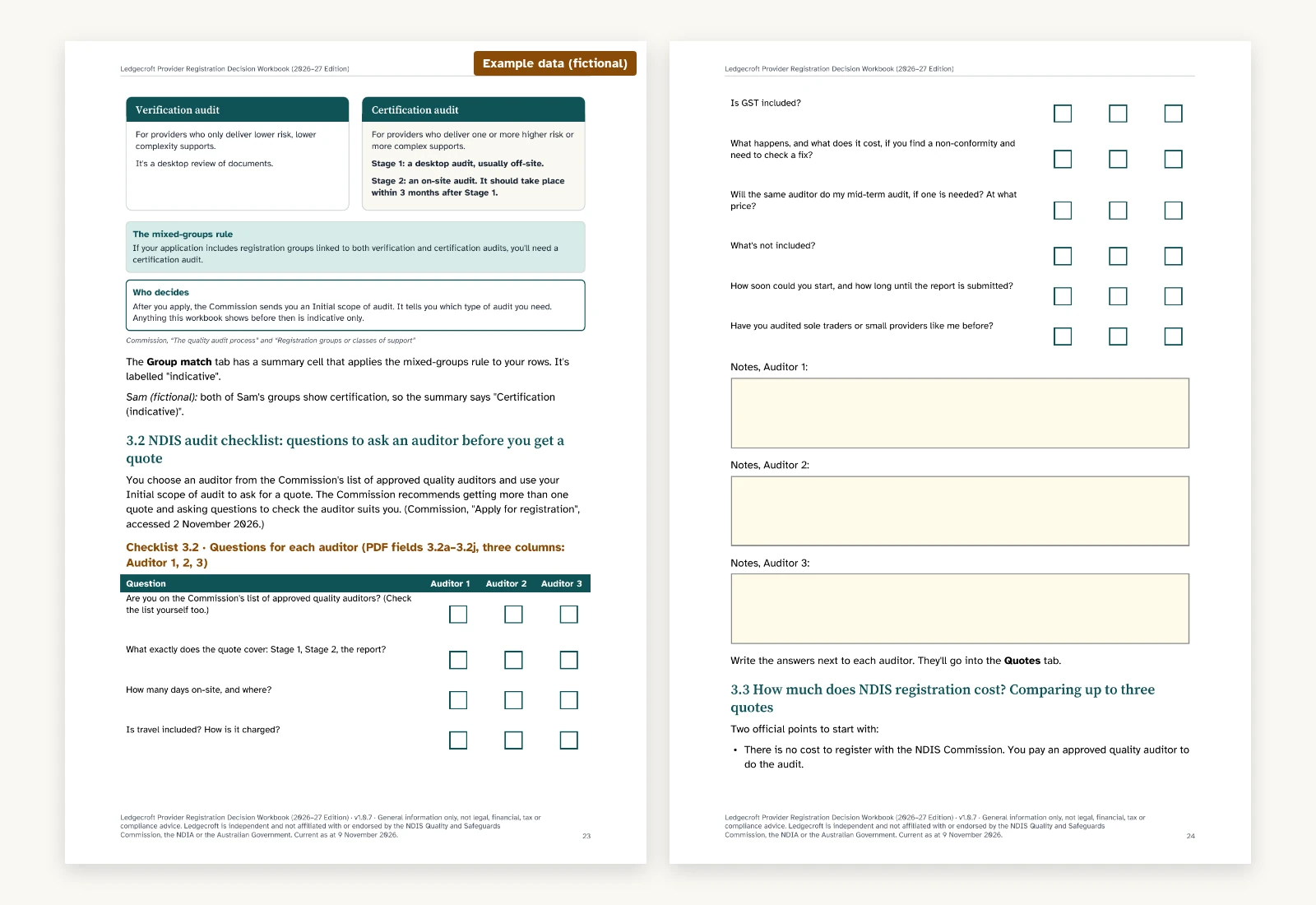
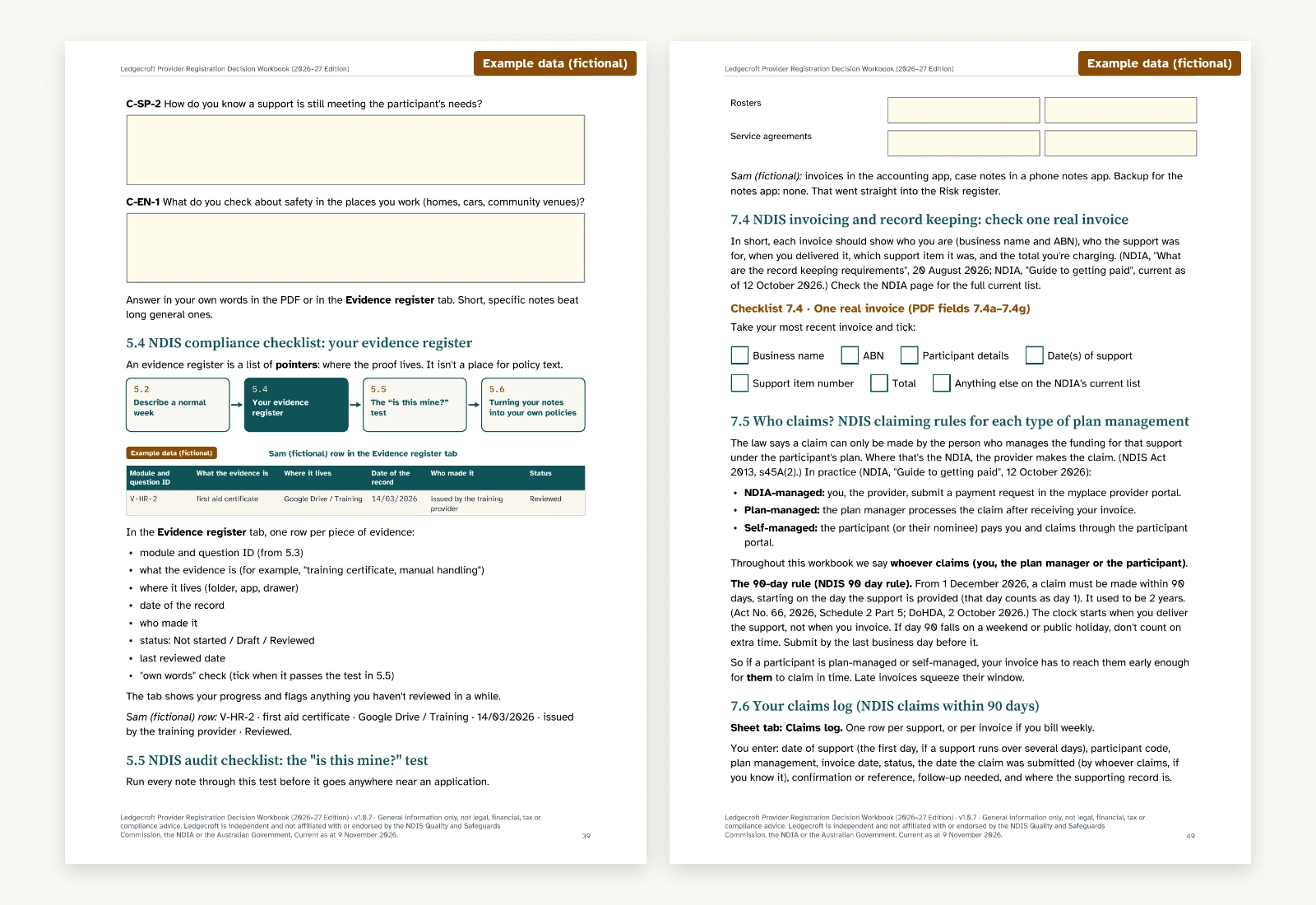
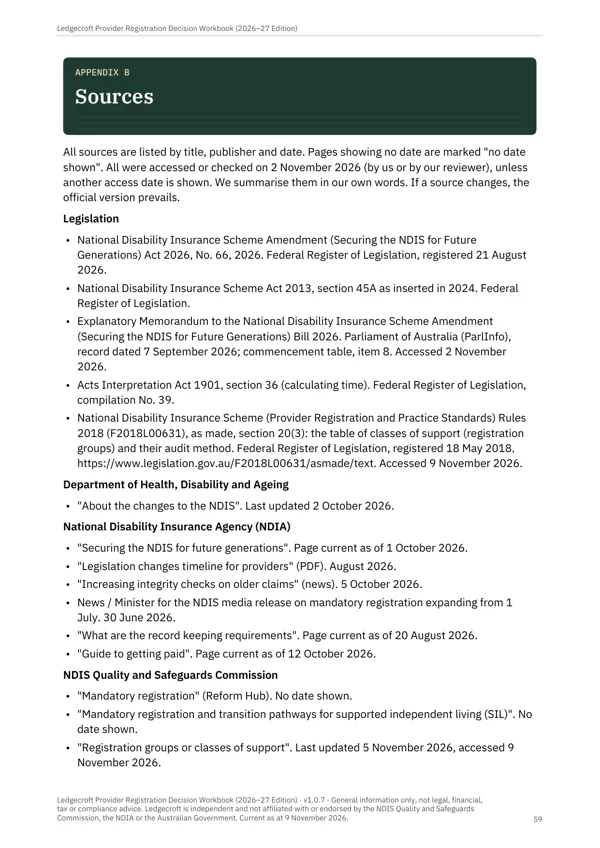
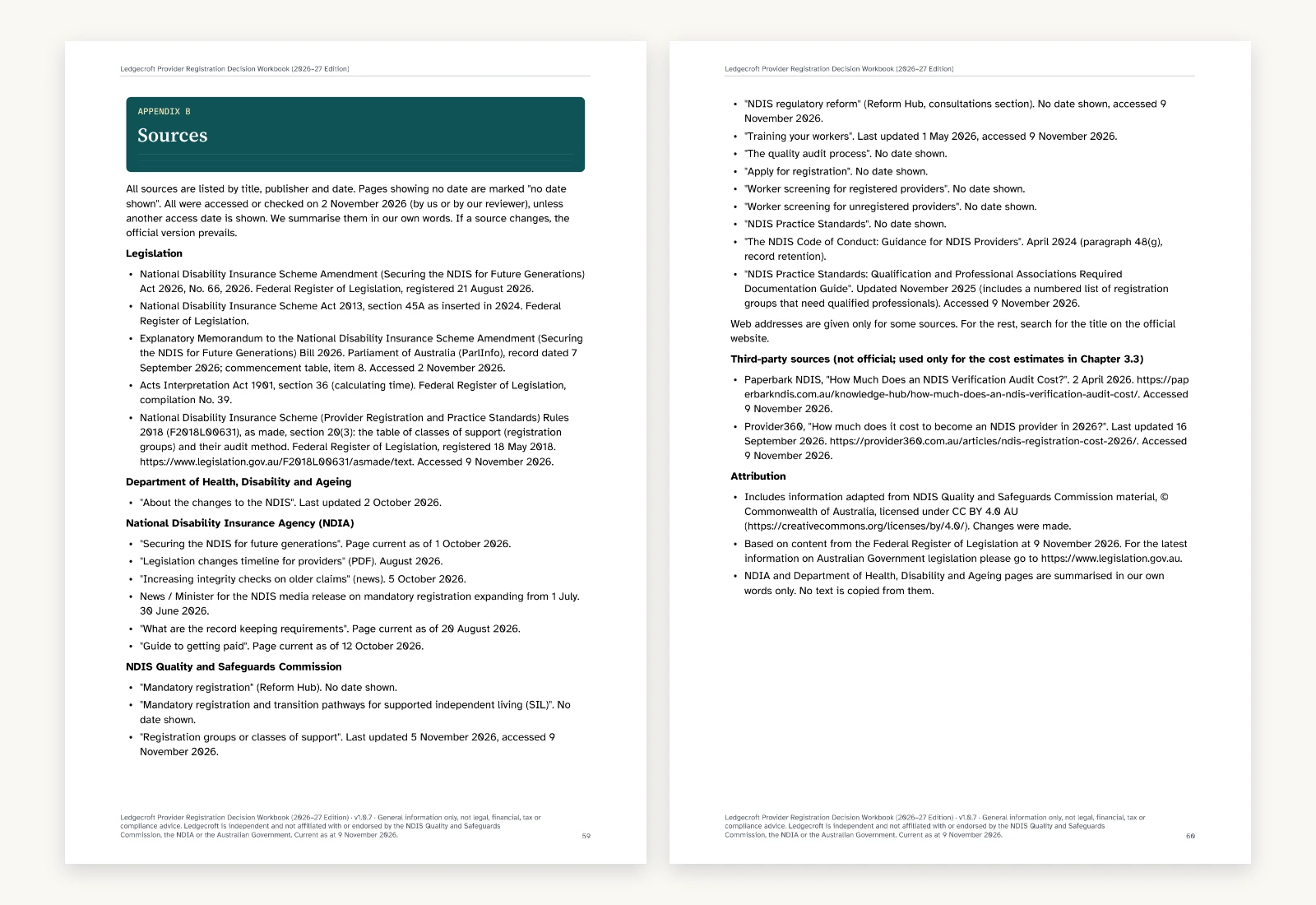
Real pages from the workbook. Where Sam appears, the example is invented.
The companion spreadsheet


What's already changed in 2026
- The new law was passed by Parliament on 19 August 2026 and got Royal Assent on 20 August 2026.
- NDIS providers have to keep records about their claims and the supports they delivered for 7 years from the day each claim is made. This applies to claims made from 27 August 2026, including when a plan manager or the participant makes the claim. The NDIS rules will set out which records.
- From 1 December 2026, claims will need to be made within 90 days of the support being delivered, by whoever claims (you, the plan manager or the participant). It used to be 2 years.
- Since 15 October 2026 the NDIA has been doing extra checks on claims made more than 90 days after the support, and can hold those payments for up to 28 days.
- Mandatory registration for SIL and NDIS digital platforms started on 1 July 2026.
- From 1 July 2027 most providers will need to enrol with the NDIA. That's separate from registration.
High risk supports: what's known as at 9 November 2026
To verify
The Government says it will publish a list of high risk supports. The examples it's given are personal care, daily living supports and supports in closed settings. Expanded registration starts rolling out from 1 July 2027, and everyone in scope has to be registered by December 2030. We found no announced date as at 9 November 2026.
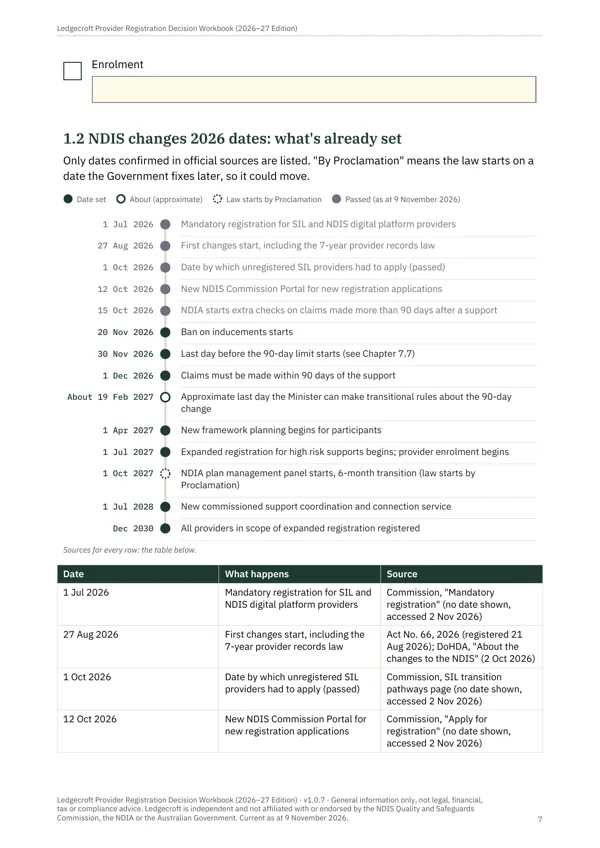
2026–2030 at a glance
From the workbook's dates table.

Sources for every date
| Date | What happens | Status | Source |
|---|---|---|---|
| 1 Jul 2026 | Mandatory registration for SIL and NDIS digital platform providers | Passed (as at 9 November 2026) | Commission, “Mandatory registration” (no date shown, accessed 9 Nov 2026) |
| 27 Aug 2026 | First changes start, including the 7-year provider records law | Passed (as at 9 November 2026) | Act No. 66, 2026; DoHDA (2 Oct 2026) |
| 1 Oct 2026 | Date by which unregistered SIL providers had to apply for registration | Passed (as at 9 November 2026) | Commission, SIL transition pathways page (no date shown, accessed 2 Nov 2026) |
| 12 Oct 2026 | New NDIS Commission Portal for new registration applications | Passed (as at 9 November 2026) | Commission, “Apply for registration” (last updated 4 Nov 2026, accessed 9 Nov 2026) |
| 15 Oct 2026 | NDIA starts extra checks on claims made more than 90 days after a support | Passed (as at 9 November 2026) | NDIA news (5 Oct 2026) |
| 20 Nov 2026 | Ban on inducements starts | Date set | Act No. 66, 2026, Schedule 2 Part 8 |
| 30 Nov 2026 | Last day before the 90-day claim limit starts | Date set | Act No. 66, 2026; DoHDA (2 Oct 2026) |
| 1 Dec 2026 | Claims must be made within 90 days of the support | Date set | Act No. 66, 2026; DoHDA (2 Oct 2026) |
| About 19 Feb 2027 | Approximate last day the Minister can make transitional rules about the 90-day change. No such rules had been identified as at 9 November 2026 | About (approximate) | Act No. 66, 2026, Schedule 5 |
| 1 Apr 2027 | New framework planning begins for participants | Date set | DoHDA (2 Oct 2026) |
| 1 Jul 2027 | Expanded registration for high risk supports begins; provider enrolment begins | Date set | DoHDA (2 Oct 2026) |
| 1 Oct 2027 | NDIA plan management panel starts, 6-month transition (law starts by Proclamation) | Law starts by Proclamation | DoHDA (2 Oct 2026); Act No. 66, 2026 |
| 1 Jul 2028 | New commissioned support coordination and connection service | Date set | DoHDA (2 Oct 2026) |
| Dec 2030 | All providers in scope of expanded registration registered | Date set | DoHDA (2 Oct 2026) |
How to check what we say
Every date and rule on this page comes from a public source. They're listed below, with who published each one and when we read it, so you can check them yourself.
- Official sources are listed by page title. Search the title on the publisher's website to read the current version.
- Not announced yet means we looked and found no date. We say when we looked ("as at").
- Third-party estimates are what other businesses have published. They're labelled that way and aren't official fees.
- Spotted something out of date? Tell us at contact@cardelith.store.
Sources
- NDIS Quality and Safeguards Commission, “Mandatory registration”. No date shown. Accessed 9 November 2026.
- NDIS Quality and Safeguards Commission, “Apply for registration”. Last updated 4 November 2026. Accessed 9 November 2026.
- NDIS Quality and Safeguards Commission, “The quality audit process”. Last updated 5 November 2026. Accessed 9 November 2026.
- Department of Health, Disability and Ageing, “About the changes to the NDIS”. Last updated 2 October 2026. Accessed 9 November 2026.
- ABC News, “Small NDIS providers and families on edge as registration ‘cyclone’ looms”, Bronwyn Herbert and Rhiannon Hobbins, 1 July 2026.
https://www.abc.net.au/news/2026-07-01/small-ndis-providers-families-on-edge-amid-registration-changes/106837522 - Paperbark NDIS, “How Much Does an NDIS Verification Audit Cost?”, 2 April 2026. Accessed 9 November 2026.
https://paperbarkndis.com.au/knowledge-hub/how-much-does-an-ndis-verification-audit-cost/ - Provider360, “How much does it cost to become an NDIS provider in 2026?”, last updated 16 September 2026. Accessed 9 November 2026.
https://provider360.com.au/articles/ndis-registration-cost-2026/
Where this fits, and where it doesn't
A comparison by type of help, not of specific products. Packs win on ready-made policies, a consultant wins on individual advice, and official sources are free and authoritative.
| This workbook | Policy / template packs | Consultant | Free official info | |
|---|---|---|---|---|
| Work through whether the changes are likely to affect you | Yes, two outcomes, never a final answer | Often written for after you've decided | Yes, for your situation | The rules, not mapped to you |
| Compare audit quotes | Planner for up to three quotes | Varies | Can advise | Says it doesn't set audit prices; suggests more than one quote |
| Evidence in your own words | Prompts, no ready-made answers | Ready-made text to tailor | Can help | Says your answers should be specific to you, not copied |
| 90-day claims and 7-year records | Claims log and records map | Varies | Varies | Yes, the source |
| Registration vs enrolment | Plain explainer | Varies | Yes | Yes, the source |
| Ready-made compliance policies | Not included | Their main purpose | Sometimes | Practice Standards and guidance |
| Individual advice | No | No | Yes | You can ask the Commission |
| Price | A$99 | Varies | Paid advice, varies | Free |
Three steps, in your own time
Decide what's likely to affect you
A guided decision tree that never gives a final answer.
Plan your costs with your own quotes
ABC News reported industry estimates of anywhere from a few thousand dollars to $15,000 or more, much of it from mandatory third-party audits. The NDIS Minister said audit costs would be set by the market. That's why the workbook includes a planner for comparing quotes from approved quality auditors before you commit.
(a) Your own quotes
| Auditor 1 | Auditor 2 | Auditor 3 | |
| Stage 1 | |||
| Stage 2 | |||
| Travel | |||
| Other | |||
| GST yes/no |
(b) Third-party estimates, not official fees
They aren't quotes, they aren't official, and your own quotes may come in higher or lower.
Verification: about $900 to $1,500
Paperbark NDIS, 2 Apr 2026 · GST not stated
https://paperbarkndis.com.au/knowledge-hub/how-much-does-an-ndis-verification-audit-cost/
Verification: about $850 · Certification: about $4,700 core only, or about $6,200 to $9,000 with specialist modules, if you already deliver supports; about $2,800 core only, or about $3,500 to $5,850 with specialist modules, if you don't yet
Provider360, last updated 16 Sep 2026 · GST not stated
https://provider360.com.au/articles/ndis-registration-cost-2026/
Auditor's fee only, not your preparation time · accessed 9 Nov 2026
Write your evidence in your own words
An evidence register with prompts, so you write about how you actually work.
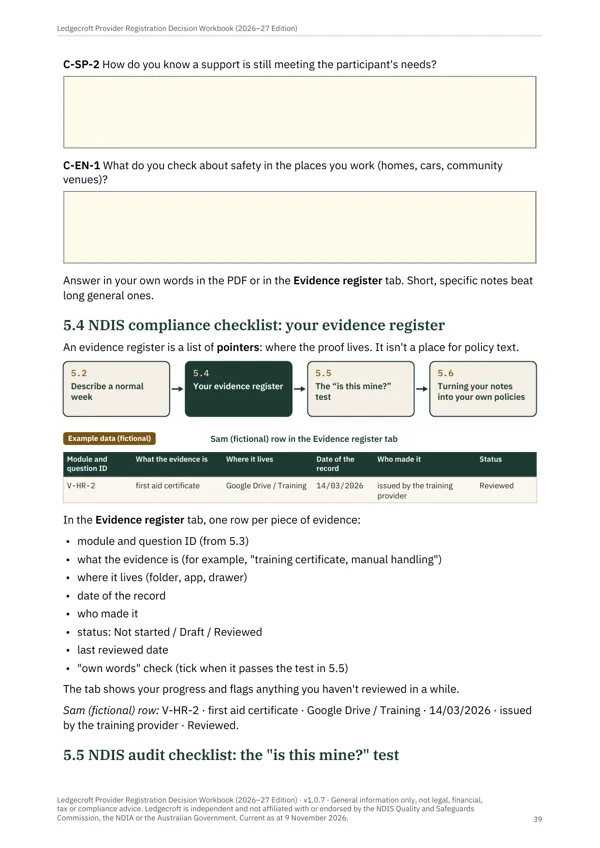 Example data (fictional)
Who it's for, and what it won't do
Who it's for
- Independent support workers, sole traders and small providers in Australia who aren't registered and want to work out where they stand.
Who it's not for
- NDIS participants and families.
- Anyone after legal, tax or financial advice.
- Anyone who needs a guaranteed registration or audit result.
What it won't do
Not included: ready-made compliance policies, legal or tax advice, an audit, registration application services, individual compliance assessments, or any guarantee of registration or audit outcomes.
Will it guarantee I pass an audit? No. Nothing can. Your auditor and the NDIS Commission make those decisions.


The Ledgecroft Provider Registration Decision Workbook (2026–27 Edition)
A$99
Once it's on sale, you'll get it from your Whop library straight after checkout.
Includes one update covering the first official list of high risk supports, sent within 30 days of its publication. No update if no list is published by 31 December 2027. Full terms in the FAQ.
No change-of-mind refunds on digital products once access is granted; your rights under the Australian Consumer Law (for example, if it's faulty or not as described) are not affected
The workbook goes on sale after our final checkout test.
Sold by Marco Martiradonna, trading as Ledgecroft · Refund policy
General information only, not legal, financial, tax or compliance advice. Ledgecroft is independent and not affiliated with or endorsed by the NDIS Quality and Safeguards Commission, the NDIA or the Australian Government.
Questions people ask
It depends on what you deliver and how your participants' funding is managed. Some supports already need registration, such as supports to participants with NDIA-managed funding. Mandatory registration for SIL and digital platforms started on 1 July 2026. From 1 July 2027 registration starts to expand to high risk supports, with everyone in scope registered by December 2030. The official list isn't out yet. The workbook never answers with a final yes or no: only “Likely affected: prepare” or “To verify when the list is published”. Under Likely affected: Rules may already apply today (SIL, digital platforms, residential aged care, or another registered-only support). Check with the Commission.
You can. Some things don't depend on the list, though. The 90-day claiming rule starts on 1 December 2026, and providers already have to keep records for claims made since 27 August 2026 for 7 years from the claim date, whoever makes the claim. The free Starter Pack covers those now.
Your purchase includes one update covering the first official list of high risk supports. It will update only the parts of the workbook that list affects, and it doesn't include individual advice or ongoing monitoring. We'll add it to your Whop library within 30 days of the list being published and email you a link to it. If the list comes out in stages, the update covers the first official publication. If no official list has been published by 31 December 2027, there won't be an update to send.
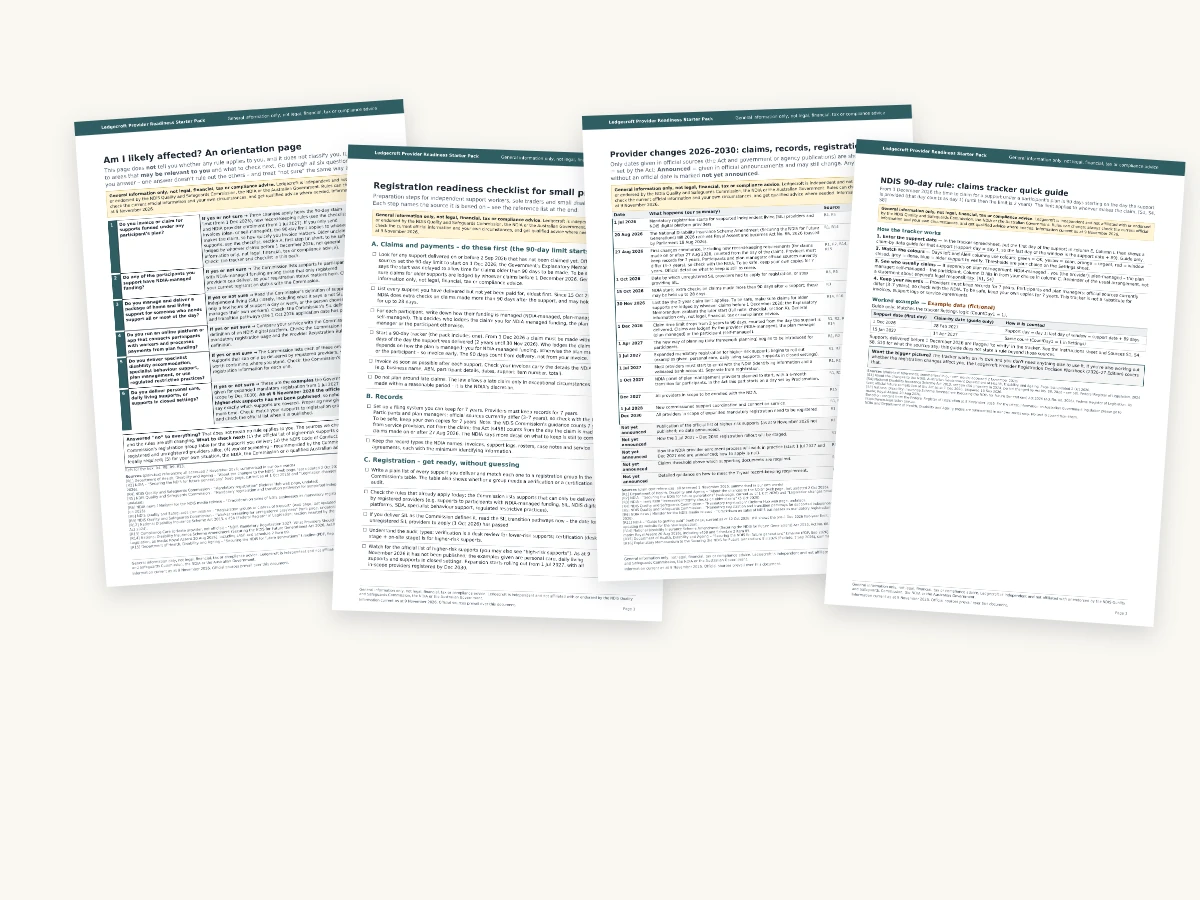
Free 90-day claims tracker and “Am I likely affected?” self-check for small providers
- A 90-day claims tracker
- A readiness checklist
- A 2026–2030 timeline
- The one-page «Am I likely affected?» guide
Get it free on Whop. Whop gives you access straight after checkout.
Want the full workbook? Not on sale yet